Taekwondo Belts in Order: Complete Guide to Every Rank and Colour

Taekwondo belts in order follow a progression from white to black, but the exact path depends on whether your school follows the World Taekwondo (WT) or International Taekwondo Federation (ITF) system. At Bushido, we’ve been manufacturing and supplying taekwondo belts to dojos across Canada for over 30 years, and we’ve seen firsthand how confusing the different belt systems can be for new students and parents. This guide breaks down both the WT and ITF taekwondo belt order, what each colour symbolizes, how long each rank takes, and what gear you’ll need along the way.
The Standard Taekwondo Belt Order
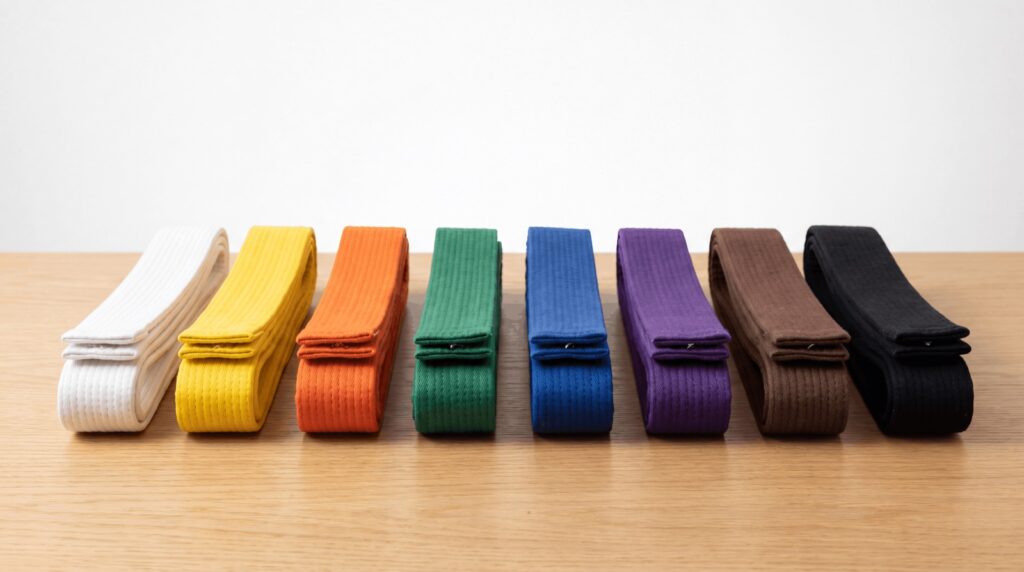
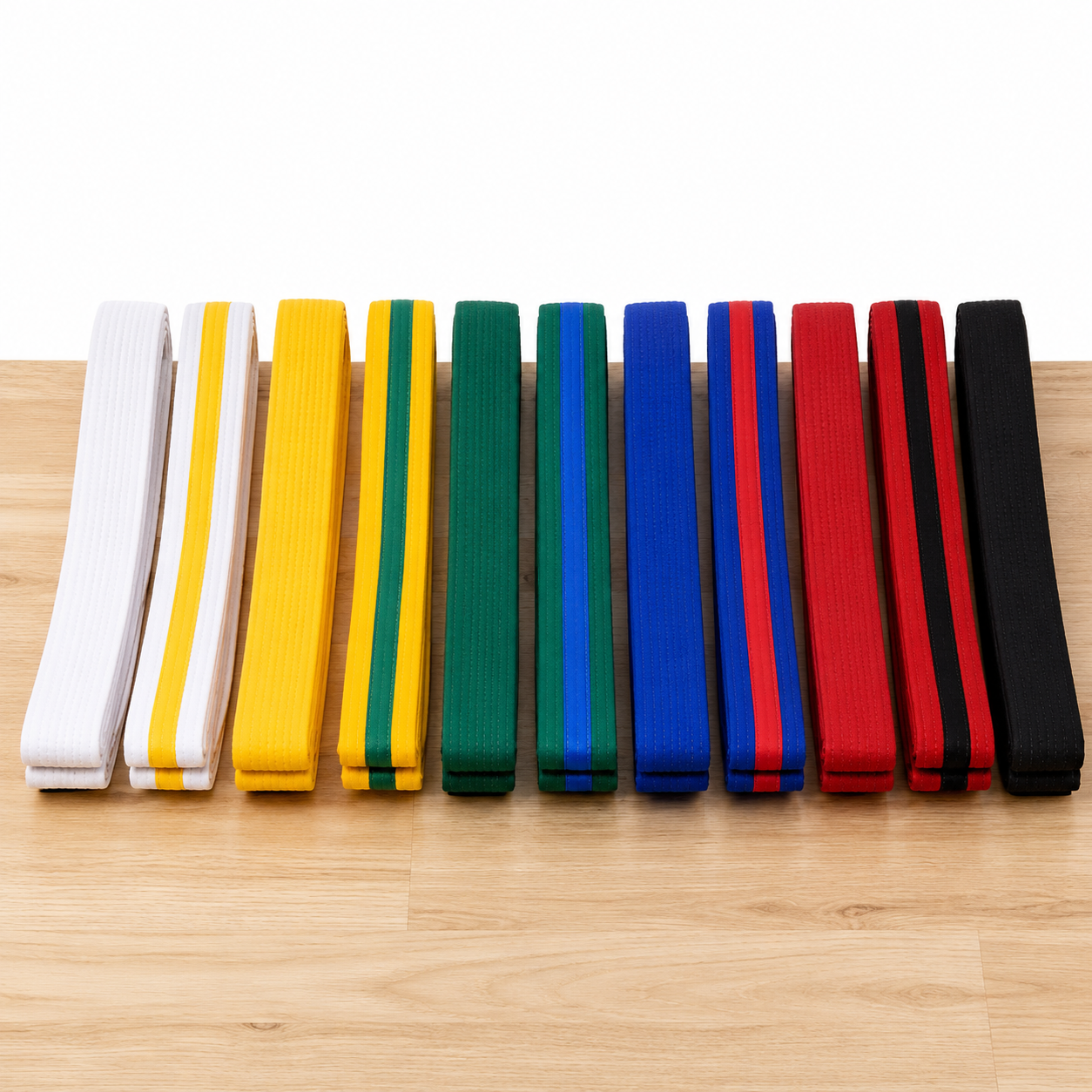
Most Canadian taekwondo schools follow the World Taekwondo (WT) system, which uses 10 coloured belt ranks (called “geup” or “gup”) before black belt:
- White Belt (10th Geup): the starting rank for all beginners
- White Belt with Yellow Stripe (9th Geup)
- Yellow Belt (8th Geup)
- Yellow Belt with Green Stripe (7th Geup)
- Green Belt (6th Geup)
- Green Belt with Blue Stripe (5th Geup)
- Blue Belt (4th Geup)
- Blue Belt with Red Stripe (3rd Geup)
- Red Belt (2nd Geup)
- Red Belt with Black Stripe (1st Geup)
- Black Belt (1st Dan)
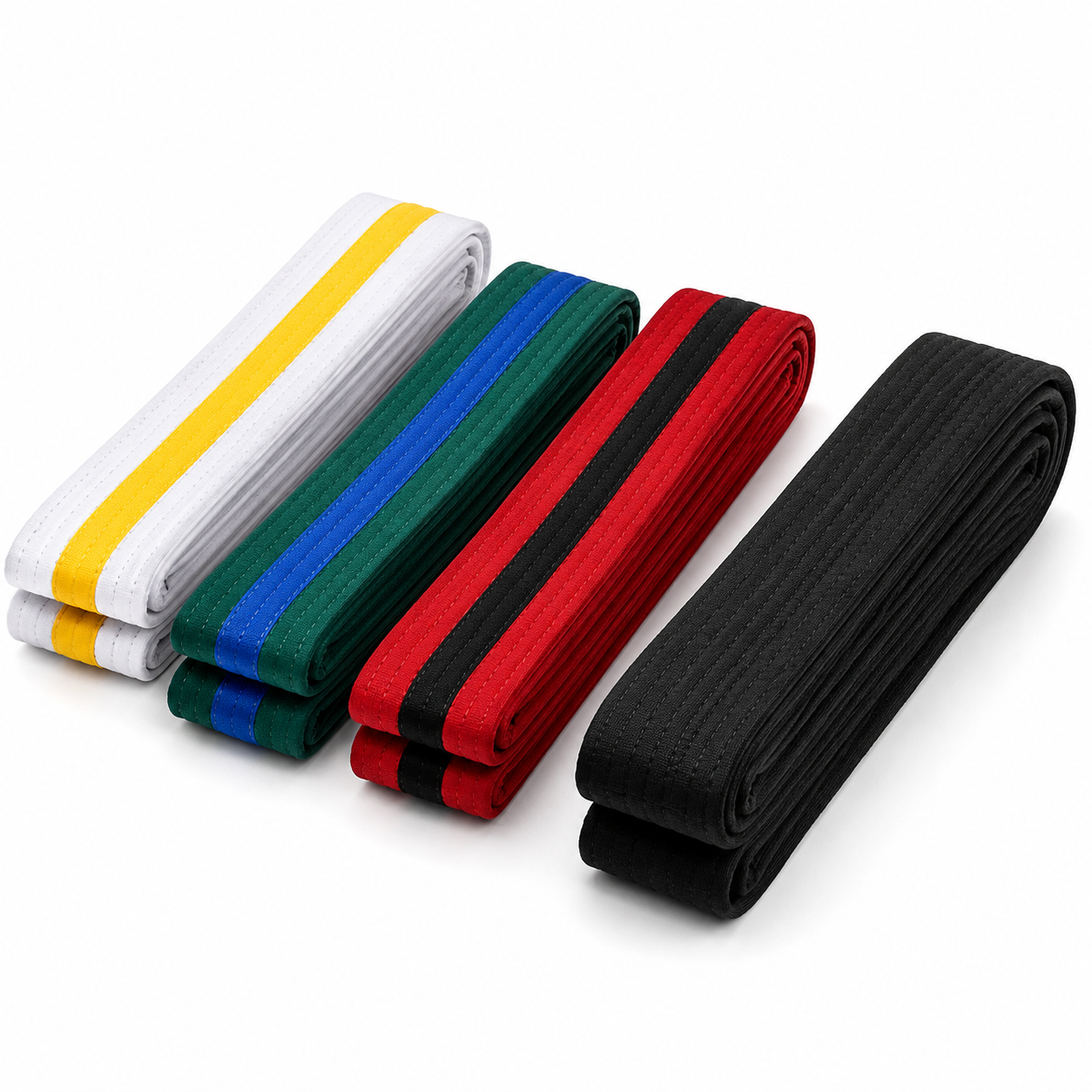
The stripe belts between each solid colour mark a halfway point in your progression. They’re not just decorative: each stripe rank has its own grading requirements. Bushido carries TKD-specific stripe belts in all five stripe combinations that match this exact progression.
If your school doesn’t use stripes, you’ll move through fewer ranks but spend more time at each one. The core colours remain the same: white, yellow, green, blue, red, black.
World Taekwondo (WT) Belt Order
The WT/Kukkiwon system is the most widely practiced worldwide and the standard used by Taekwondo Canada for national competitions. Here’s the complete WT taekwondo belt ranking:
| Geup Rank | Belt Colour | Bushido Product | Price |
|---|---|---|---|
| 10th Geup | White (solid) | Drako Regular Belt | $7.95 |
| 9th Geup | White with Yellow Stripe | Drako TKD Striped | $8.95 |
| 8th Geup | Yellow (solid) | Drako Regular Belt | $8.95 |
| 7th Geup | Yellow with Green Stripe | Drako TKD Striped | $8.95 |
| 6th Geup | Green (solid) | Drako Regular Belt | $8.95 |
| 5th Geup | Green with Blue Stripe | Drako TKD Striped | $8.95 |
| 4th Geup | Blue (solid) | Drako Regular Belt | $8.95 |
| 3rd Geup | Blue with Red Stripe | Drako TKD Striped | $8.95 |
| 2nd Geup | Red (solid) | Drako Regular Belt | $8.95 |
| 1st Geup | Red with Black Stripe | Drako TKD Striped | $8.95 |
| 1st Dan | Black | Drako 2inch Black Belt | $15.95 |
All Drako belts use a 100% cotton shell with a poly/nylon felt centre. They’re colourfast, meaning the dye won’t run or bleed when they get sweaty: something you’ll appreciate after a hard sparring session. You can find the full range of solid colour belts and striped belts on our site.
ITF Belt Order
The International Taekwondo Federation uses a different progression. ITF schools (sometimes called “Chang Hon” or “traditional” taekwondo) use 10 numbered ranks called “gup” that count down from 10th to 1st:
| Gup Rank | Belt Colour |
|---|---|
| 10th Gup | White |
| 9th Gup | White with Yellow Stripe |
| 8th Gup | Yellow |
| 7th Gup | Yellow with Green Stripe |
| 6th Gup | Green |
| 5th Gup | Green with Blue Stripe |
| 4th Gup | Blue |
| 3rd Gup | Blue with Red Stripe |
| 2nd Gup | Red |
| 1st Gup | Red with Black Stripe |
| 1st Dan | Black |
You’ll notice the colours are nearly identical to the WT system. The main differences show up in grading requirements, not belt colours. ITF schools test on different patterns (called “tul” instead of WT’s “poomsae”), and the sparring rules are different: ITF uses light-contact continuous sparring while WT uses electronic scoring gear.
Some ITF schools add orange, purple, or brown belts between the standard colours. If your school uses these, ask your instructor where they fall in the ranking: it varies by organization.
WT vs ITF: Belt Order Comparison
| Rank Level | WT / Kukkiwon | ITF / Chang Hon | Key Difference |
|---|---|---|---|
| Beginner | White → Yellow | White → Yellow | Same progression |
| Intermediate | Green → Blue | Green → Blue | Same colours, different patterns tested |
| Advanced | Red → Red-Black | Red → Red-Black | WT tests poomsae; ITF tests tul |
| Black Belt | Dan (Kukkiwon certified) | Dan (ITF certified) | Different certifying body |
| Junior Black | Poom Belt (under 15) | No equivalent | WT-only distinction |
| Competition Gear | Electronic scoring | Light-contact, no electronics | Different gear required |
Which system does your school use? In Canada, most schools are WT-affiliated and register through provincial taekwondo associations under Taekwondo Canada. If your school competes at the Olympics or national championships, it’s almost certainly WT. ITF schools are also common but operate under separate organizations.
If you’re not sure, check whether your school teaches “poomsae” (WT) or “tul” (ITF) as their forms curriculum. That’s the quickest way to tell.
What Each Taekwondo Belt Colour Means
Each belt colour in the taekwondo belt ranking carries symbolic meaning rooted in Korean philosophy and nature:
| Belt Colour | Symbolism |
|---|---|
| White | Innocence and purity: the student begins with no knowledge |
| Yellow | The earth: the seed has been planted, roots are forming |
| Green | Growth: the plant is sprouting, techniques are developing |
| Blue | The sky and heaven: the student reaches upward |
| Red | Danger and warning: the student has power but must learn control |
| Black | Maturity and mastery of the basics: the student is ready to begin real study |
The stripe belts between colours represent a transitional phase. A yellow belt with a green stripe means you’ve started learning green belt material but haven’t mastered it yet. Think of it as being halfway between two levels.
One thing that surprises people: a black belt doesn’t mean you’ve mastered taekwondo. In Korean martial arts philosophy, it means you’ve built a strong enough foundation that the real learning can begin. The Dan ranks above 1st Dan are where true mastery develops over decades.
How Long Does Each Taekwondo Belt Take?
Here’s a realistic timeline for the taekwondo belts in order, assuming you train 2 to 3 times per week (this will vary between schools and programs):
| Belt Transition | Average Time | Cumulative from White |
|---|---|---|
| White to Yellow | 3 to 4 months | 3 to 4 months |
| Yellow to Green | 4 to 5 months | 7 to 9 months |
| Green to Blue | 4 to 6 months | 11 to 15 months |
| Blue to Red | 5 to 7 months | 16 to 22 months |
| Red to Black (1st Dan) | 8 to 12 months | 2 to 3 years |
If your school uses stripe belts, each stripe typically adds 2 to 3 months to the progression, making the total journey closer to 3.5 to 5 years.
These timelines vary. Some schools have minimum time-in-grade requirements that prevent you from testing early. Training frequency matters most: students who train once a week will take roughly twice as long. Kids usually take longer because grading expectations scale with age, and many children’s programs add extra stripe levels as motivational milestones.
The Kukkiwon (World Taekwondo’s certification body) requires a minimum of one year between 1st Dan testing eligibility and the start of training. After that, each subsequent Dan rank requires progressively longer minimum wait times: 2 years for 2nd Dan, 3 years for 3rd Dan, and so on.
What Gear You Need at Each Belt Level
Your taekwondo equipment needs grow as you advance through the ranks. Here are some suggestions for both WT and ITF Taekwondo.
White to Green Belt (Beginner)
A dobok (taekwondo uniform) is your first purchase. Bushido’s Drako Dynamite Student TKD Dobok starts at $45.95 and handles everything a beginner needs.
Your belt: a Drako Single Wrap Belt at $7.95 or a Drako Regular Belt at $8.95. Most schools include a white belt with your first dobok purchase. A mouthguard is also worth picking up for sparring classes.
Blue to Red Belt (Intermediate)
Sparring gear becomes essential at this stage. You’ll need:
- Chest protector: the Drako 2KO TKD V-Chestguard ($65.90) is our most popular.
- Headgear: Drako Foam Headgear ($55.95).
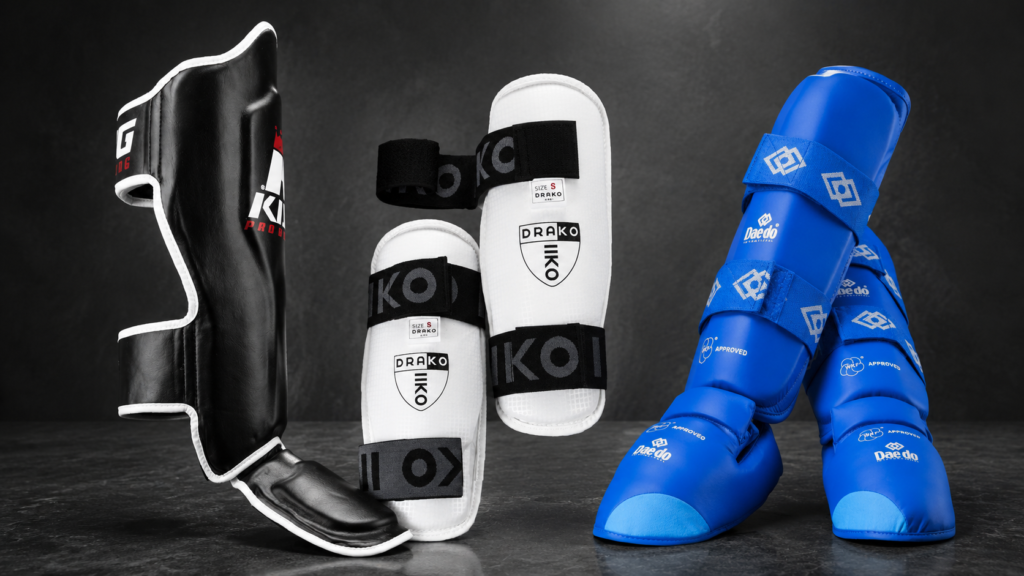
- Shin guards: Drako 2KO TKD Shin V-Guards ($35.95).
- Arm guards: Drako 2KO TKD Arm V-Guards ($34.90).
- Foam punches: Drako Foam Punches ($49.95).
- Foot protectors: Drako Foam Kicks ($41.95 to $49.95).
If you plan to compete at WT-sanctioned tournaments, you’ll need electronic scoring gear (e-chest protectors and e-headgear) approved by your provincial association.
Red-Black Stripe to Black Belt (Advanced)
A higher-quality dobok: the Daedo WT Club Dobok ($64.90) or a competition-grade Daedo WT Competition Uniform ($179.90) if you’re competing seriously.
A quality black belt you’ll keep for years: the Drako 2inch Black Belt ($15.95) for everyday training, or the Daedo Black Belt 5cm ($29.90) as a premium option for testing and ceremonies.
Taekwondo shoes: optional but increasingly common at higher ranks, especially for instructors and competitors. Daedo is the most popular brand sold in Canadian dojos.
Kids vs Adult Taekwondo Belts
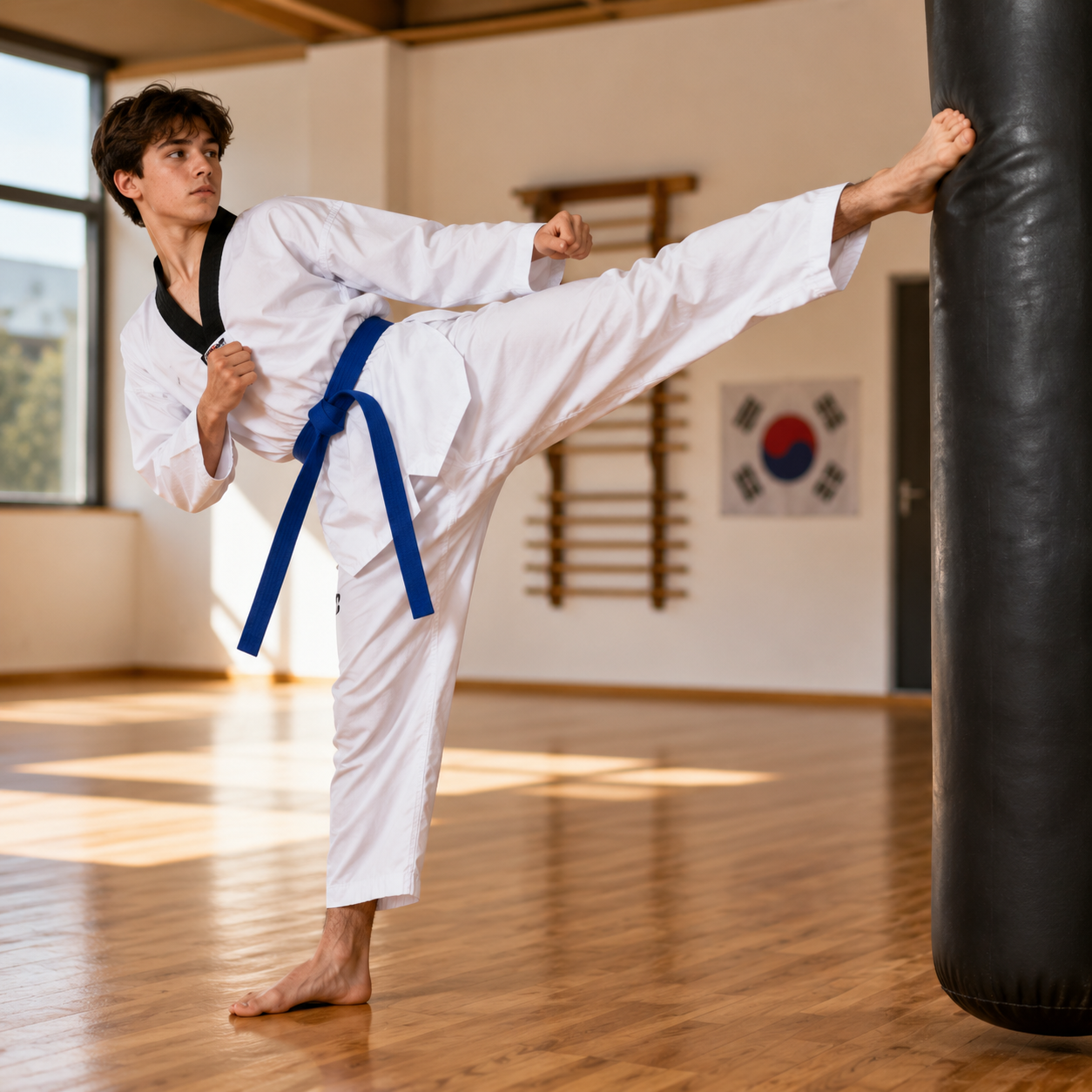
Most schools use the same taekwondo belt order for kids and adults, but with more steps in between. Instructors add half-colour stripe belts and tip systems to create frequent milestones that keep younger students motivated.
The WT system has a unique feature for junior practitioners: the Poom belt. When a student under 15 years old passes their black belt test, they receive a Poom belt (half red, half black) instead of a full black belt. The Poom rank converts automatically to a full Dan rank when the student turns 15 (for 1st Poom) or 18 (for 2nd to 3rd Poom).
At Bushido, we carry TKD striped belts ($9.95) in every stripe combination your school might use: white with yellow, yellow with green, green with blue, and more. For youth programs that use colour tip systems, we can also do custom embroidery and striping with quick turnaround.
Dan Ranks: Black Belt and Beyond
Earning a black belt isn’t the finish line: it’s the starting block for the Dan ranking system. Dan ranks count upward: 1st Dan is the beginning, and the numbers increase from there.
| Dan Rank | Korean Title | Typical Time to Earn | Min Age (WT) |
|---|---|---|---|
| 1st Dan (Ildan) | Black Belt | 3 to 5 years from white | 15 |
| 2nd Dan (Idan) | — | 2+ years after 1st Dan | 17 |
| 3rd Dan (Samdan) | — | 3+ years after 2nd Dan | 20 |
| 4th Dan (Sadan) | Master Instructor | 4+ years after 3rd Dan | 25 |
| 5th Dan (Odan) | — | 5+ years after 4th Dan | 30 |
| 6th Dan (Yukdan) | — | 6+ years after 5th Dan | 36 |
| 7th Dan (Childan) | Master | 7+ years after 6th Dan | 43 |
| 8th Dan (Paldan) | Grandmaster | 8+ years after 7th Dan | 51 |
| 9th Dan (Gudan) | — | 9+ years after 8th Dan | 60 |
The Kukkiwon sets these minimums globally. Most practitioners spend their entire career between 1st and 4th Dan. Reaching 5th Dan and above requires decades of teaching, competition, and contribution to the sport. 9th Dan is the highest rank typically awarded to living practitioners: 10th Dan is extremely rare and usually honorary.
If you’re interested in how this compares to the karate ranking system, we covered the full karate belt order in our karate belts in order guide.
Frequently Asked Questions
What is the order of belts in taekwondo?
The standard taekwondo belt order is white, yellow, green, blue, red, and black. Most schools add stripe belts between each colour (white-yellow stripe, yellow-green stripe, green-blue stripe, blue-red stripe, red-black stripe) for a total of 10 coloured ranks before black belt. The exact progression depends on whether your school follows the WT or ITF system.
How many belts are in taekwondo in Canada?
Most Canadian taekwondo schools follow the World Taekwondo (WT) system with 10 coloured belt ranks (5 solid colours + 5 stripe colours) before black belt. Some schools add additional intermediate ranks, bringing the total to 12 to 15 before black belt. After black belt, there are 9 Dan ranks, though most practitioners progress through 1st to 4th Dan.
How long does it take to get each belt in taekwondo?
Each coloured belt takes 3 to 7 months of regular training (2 to 3 sessions per week). Stripe belts typically take 2 to 3 months. The full journey from white to 1st Dan black belt averages 3 to 5 years. Training once a week roughly doubles the timeline. Children’s programs often take longer because grading criteria scale with age.
What belt is Chuck Norris in taekwondo?
Chuck Norris holds black belts in Tang Soo Do (a Korean martial art closely related to taekwondo) and several other martial arts. He earned his 8th-degree black belt in Tang Soo Do and was one of the first westerners to achieve high-ranking belts in Korean martial arts. While Tang Soo Do and taekwondo share Korean roots, they are separate disciplines with different belt systems.
What do different belt colours signify in taekwondo?
Each colour represents a stage of growth rooted in Korean philosophy. White represents innocence and purity. Yellow symbolizes the earth where a seed is planted. Green represents growth and sprouting techniques. Blue represents the sky the student reaches toward. Red signals danger and the power that demands control. Black represents maturity and the readiness for deeper study. The stripe between each colour marks the transition phase between two levels.
Find Your Next Belt at Bushido
Whether you’re picking up your first white belt or upgrading to a quality black belt for your Dan grading, we carry every colour and stripe combination in the taekwondo belt order. Browse our full selection of taekwondo belts and taekwondo gear, or call us at 604-513-0317 if you need help choosing. Free shipping on orders over $125 across Canada.